Gamifying the way you learn is crucial as it helps you motivate and improve your study. Gamification help develop an approach for increasing learners’ motivation and engagement by incorporating game design elements in educational environments.
Proponents of gamification reinforce necessary skills in education, such as problem-solving, collaboration, and communication, and learning becomes visible through progress indicators. Students may uncover an intrinsic motivation for learning, explore different identities through different avatars or characters, and are more comfortable in gaming environments, so they are more proactive and open to making mistakes. More importantly, students feel like they have ownership over their learning.
The benefits of Gamification can be many as it desires to combine intrinsic motivation with extrinsic one to raise motivation and engagement. Intrinsic motivations come from within; the user/actor decides whether to make an action or not; some examples are altruism, competition, cooperation, sense of belonging, love or aggression. Extrinsic motivations, on the other hand, occur when something or someone determines the user to make an action, for example, classifications, levels, points, badges, awards, missions (Viola, 2011)
When designing the Gamification of the course, we try to answer the following questions: why do we gamify a service, what are the goals and what are the benefits expected. It is essential to take into consideration the subject we are addressing.
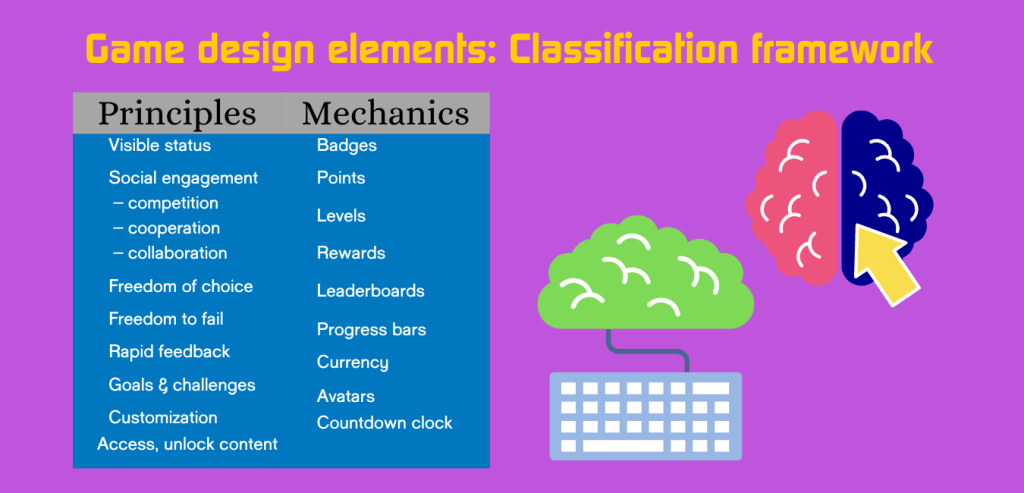
Common game design principles are visible status, social engagement, freedom of choice, freedom to fail, and rapid feedback (Dicheva et al., 2015). Visible status informs students about a task’s completion status or else shows students how they are progressing. Social engagement feeds into purported needs for competition against individuals or teams (O’Donovan et al., 2013). Still, it may include team projects and group learning opportunities (Mak, 2013) and cooperation and interaction with classroom peers (Landers and Callan, 2011). Freedom of choice implies that students are free to choose whichever task(s) they want to complete.
Simply adding game mechanics to a non-game situation to make it less boring is a narrow view of Gamification. A broad definition of Gamification incorporates the building of a game to promote the learning of specific content (Serious games and play-based learning). (Kapp, 2012, p. 16 – 17)
Another essential element of constructivism is collaboration. Collaboration is a valuable 21st Century skill that enables students to generate more profound levels of knowledge, think critically and creatively and share a learning goal with others. Game designers and educators need to work together to ensure that games are engaging and consider the constraints of the classroom environment. A good game-based learning application would also include support materials such as instructions, teacher training and lesson plans (Routledge, 2009). Further research into the impact of games on students should positively affect fun design in the future (Routledge, 2009).
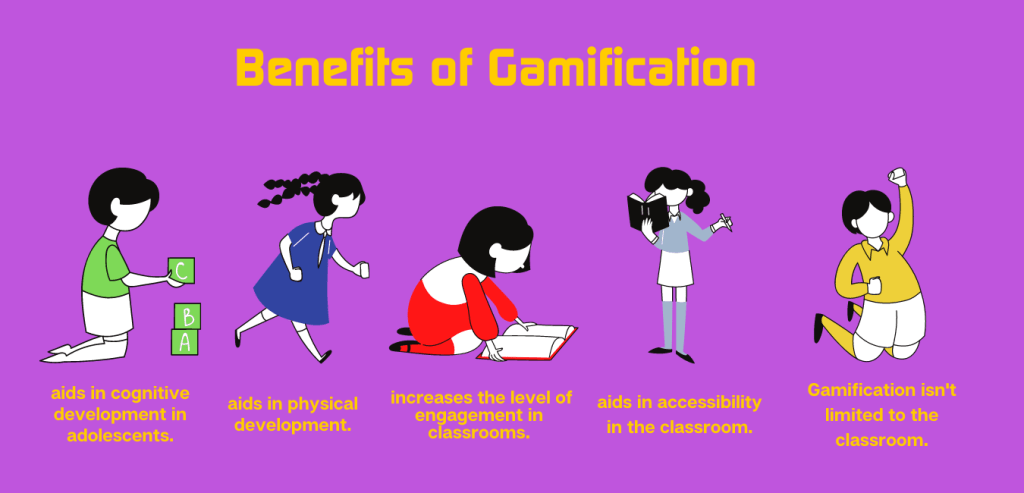
Gamification of learning is applying game design elements to learning activities – it is currently a hot, if controversial, trend in education. Gamification makes teaching more fun and engaging without undermining its credibility and helps students gain motivation towards studying. Also, they get pushed forwards because of the positive feedback and become more interested and stimulated to learn.
Overall, we can use this means to create more effective and engaging e-learning applications. Gamification can constitute a powerful boost to determine them to study/read more.
Reference
Muntean, C.I., 2011, October. Raising engagement in e-learning through gamification. In Proc. 6th international conference on virtual learning ICVL (Vol. 1, pp. 323-329).
Dichev, C., Dicheva, D. Gamifying education: what is known, what is believed and what remains uncertain: a critical review. Int J Educ Technol High Educ 14, 9 (2017). https://doi.org/10.1186/s41239-017-0042-5
Kapp, K. M. (2012). The gamification of learning and instruction : game-based methods and strategies for training and education. Wiley. Retrieved from EBook Library.
Rabah, J., Cassidy, R. and Beauchemin, R., 2018, November. Gamification in education: Real benefits or edutainment. In Kidmore End: Academic Conferences International Limited (pp. 489-496).
Routledge, H. (2009). Games-based learning in the classroom and how it can work!. In T. Connolly, M. Stansfield, & L. Boyle (Eds.) Games-Based learning advancements for multi-sensory human computer interfaces: Techniques and effective practices. 274-286. Hershey, PA: . doi:10.4018/978-1-60566-360-9.ch016.
Digital Essay – The Gamification of Learning | Virtual Quest (2015). Available at: https://thinkspace.csu.edu.au/diginanna/2015/05/30/digital-essay-the-gamification-of-learning/ (Accessed: 7 May 2021).
 moon.wysl