We have been swiftly going about more into ethical, environmental, healthy concepts and cautious of what we are doing. Health is a significant part of our everyday lives, so why not gamify it? Gamifying your exercise through an app store fitness tracker can help boost you to form healthy habits. Gamification is transforming the health industry and offer advantages for motivating behaviour change for health and well-being to improve the human condition. Due to the impact of technology, changing customer demands and the general adoption of new habits.
Gamification will change the traditional image of healthcare by using technology as a catalyst for change. Applying gamification in healthcare will change how you interact with your doctor and your family- so that everyone can be healthier. Improve patient clinical outcomes, monitor progress, and select the most appropriate ones for a given patient. This trend establishes the need for a “digital practitioner.”
With the explosion of healthcare game products, patients compete with themselves by challenging personal goals to achieve high score validation, whereas, in other applications, patients compete against other individuals. Moreover, engaging patients by gamifying and motivating patient-controlled behaviours in term of gamification has already been studied in a wide variety of disease states. Therefore, it attracts researchers in the e-health realm in the second half of 2010.
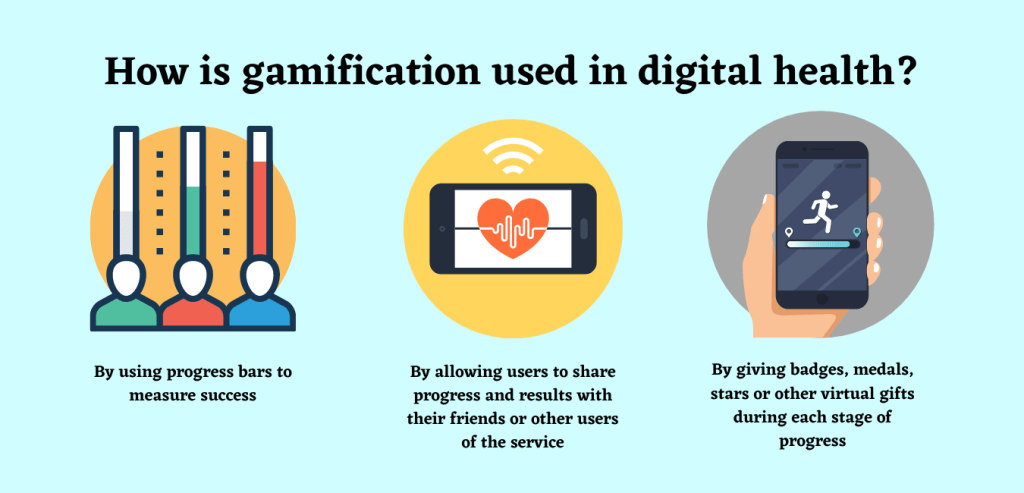
By integrating software design and game mechanics with public health theory and behavioural insights, patients can improve their health on the application and smartphones. The health industry is quickly changing due to the impact of technology, shifting customer expectations and the general adoption of new habits. Gamification provides a powerful catalyst for change. The result? Consumers are learning and having fun at the same time! It is the new way of learning to make medical operations fun and interesting.
Thus, increase in the perceived value of the service and motivation levels by invoking progress-related psychological biases and elicit more or better use of the service. These are applications on the phone like, medication adherence programs, health education, weight loss apps, fitness apps and chronic disease management apps. Using real-time biofeedback from motion-capture sensors and gesture-control technology, it great for patients and some telehealth programs to educate patients, health workers and the general populace in remote and rural areas.
With gamification, the healthcare industry can improve and a fun way to increase engagement across healthcare organizations. I believe that the future of healthcare looks a lot like the present of gaming and is to create better healthcare on a mission to empower clinicians, patients and caregivers. In my opinion, gamification help healthcare is essential and selectively applied to how care is coordinated and delivered to patients, potentially leading to better outcomes.
There is many more gamification regrading on health applications that I been using as I would love to recommend some of the application that I been using:
My Fitness Pal
It is a smartphone app and website that tracks diet and exercise. The app uses gamification elements to motivate users. Users can either scan the barcodes of various food items or manually find them in the app’s sizeable pre-existing database to track nutrients.
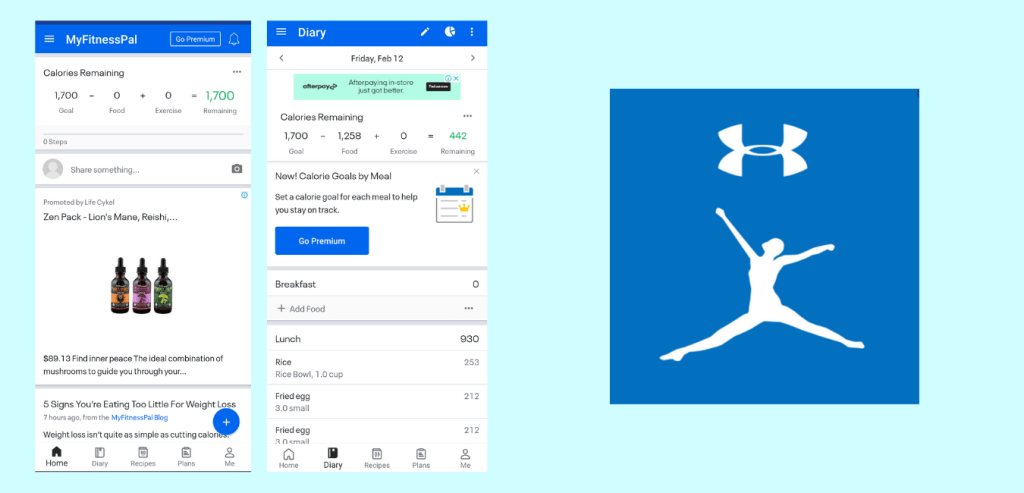
I have used this to track how many calories to consume, and the reason behind it is that I want to lose weight and eat healthier.
Step Tracker
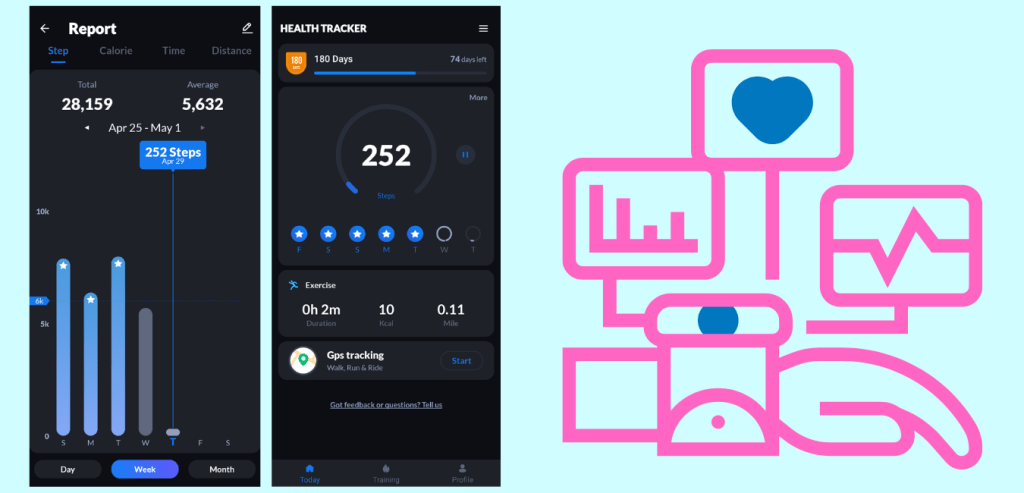
Step Tracker application, which is helping me keep an eye on their activity levels by tracking the number of steps a person takes.
The app may also generate graphs and statistics relating to a person’s physical activity. This allows me to monitor my level of activity in greater detail.
I start a custom weight loss program and helps me adopt healthy habits to lose weight and keep it off. It is customized to my goals and fitness needs.
Get your health application to adventure your weight loss journey and be health-conscious.
Reference
| King, D. et al. (2013) ‘‘Gamification’: Influencing health behaviours with games’, Journal of the Royal Society of Medicine, 106(3), pp. 76–78. doi: 10.1177/0141076813480996. Cudney, Elizabeth A., Murray, Susan L., Sprague, Connor M., Byrd, Lalaine M., Morris, Frances M., Merwin, Nathaniel & Warner, Debra L. 2015, ‘Engaging Healthcare Users through Gamification in Knowledge Sharing of Continuous Improvement in Healthcare’, Procedia Manufacturing, vol. 3, pp. 3416-3423. King, D. et al. (2013) ‘‘Gamification’: Influencing health behaviours with games’, Journal of the Royal Society of Medicine, 106(3), pp. 76–78. doi: 10.1177/0141076813480996. Phillips Jr, E.G., Nabhan, C. and Feinberg, B.A., 2019. The gamification of healthcare: emergence of the digital practitioner. Am J Manag Care, 25(1), pp.13-15. Vancouver Johnson, D., Deterding, S., Kuhn, K.A., Staneva, A., Stoyanov, S. and Hides, L., 2016. Gamification for health and wellbeing: A systematic review of the literature. Internet interventions, 6, pp.89-106. Vancouver |
 moon.wysl