“There’s no one without purpose in a game. That’s what Gamification is all about.”
― Vineet Raj Kapoor
Our social life has been linked and integrated with the digital world of technology and internet access—our lifestyle changes as technology advances for our convenience and better quality of life. The generation now has been the most avid consumer of the online world and with its benefits and we extremely receptive and adapted to the unprecedented advancement. Our perception on social life has changed drastically due to the pandemic and have been upgraded in the way we share our life experience. With the popularity of social media platforms like Tik Tok, Twitter, Instagram and so on, we are more than connecting and broadcasting our lives globally by sharing our moments via a post or short video clips. Add Image Digitally speaking, we have advanced with our online Personas going into “gamification” modes and features.
The big tech companies have been involving and investing in more game-like contents. The last 15 years have seen the rise of the digital game medium in entertainment, popular culture, and the academic field. While social networking has already demonstrated its efficiency in e-learning, Gamification, which uses game-thinking and playful design in non-game contexts, has only shown its potential as a motivational tool. The idea of our life as a game is not new.
The variety of the activities that we do have been rewarded points for doing voluntary work, which we do every day and have reflected on our social status. Online communities and social networks offer individuals the opportunity to engage with like minds, generate discussion and build relationships around specific topics. In two papers, Bista et al. (2012a, 2012b) outlined the design of a government-sponsored online community for individuals receiving welfare interested in returning to the workforce. So what is Gamification, and how does it apply to social media.
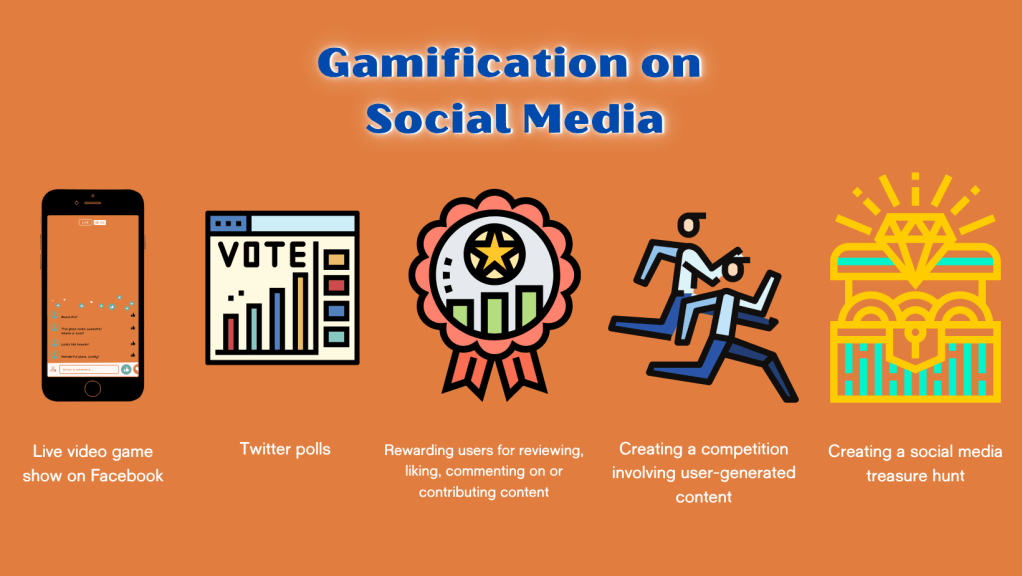
Gamification has two key ingredients: it is used for non-entertainment purposes. It draws inspiration from games, particularly the elements that make up games without engendering a fully-fledged game. Thus transforming ‘game of life to the new meaning of our social contexts. Without realising that we been using some sort of Gamification, it creates our social progress feeling awarded, achieved and tangible. Humans have evolved to be stimulating with problem-solving, learning and gameplay and, in return, small rewards for incremental progress.
Cramer et al. (2011) investigated how people were motivated to use Foursquare, a location-sharing app known for its use of status in the form of “mayorships” earned by frequent customers. Results indicated that motivation through Gamification was mixed. For example, motivation dropped when mayorships were perceived to be unobtainable. Gamification is currently driven by video games’ success and momentum, but it also draws on different psychological theories, primarily using motivational models. Self-determination theory (Ryan & Deci, 2000) identifies two types of motivation, extrinsic and intrinsic, and depicts a sort of continuum from one to the other. In the world of academics, practitioners, and business professionals in domains as diverse as education, information studies, human-computer interaction, and health, we noticed the importance of Gamification applied to help develop an approach for encouraging user motivation, engagement and enjoyment in non-gaming, computer-mediated environments.
Gamification is excellent for use in different professional areas and personal to better and improve how we live, work and think efficiently in our daily lives. Life will undoubtedly make this game a little more rewarding and worth playing.
I would love to explore more what Gamification can influence and benefits like structure, which can be recorded and documented and permit authentic sharing of experiences while also rewarding the players. It is bound to make people think twice before they upload anything on the internet and undertake challenges only if they can complete them.
Stay tuned to the next blog.
References
de-Marcos, Luis, Domínguez, Adrián, Saenz-de-Navarrete, Joseba & Pagés, Carmen 2014, ‘An empirical study comparing gamification and social networking on e-learning’, Computers & Education, vol. 75, June 2014, pp. 82-91.
Seaborn, K. and Fels, D.I., 2015. Gamification in theory and action: A survey.International Journal of human-computer studies, 74, pp.14-31.https://www.sciencedirect.com/science/article/abs/pii/S1071581914001256
William, H.(Jan 14, 2019) The Gamification of Social Media.https://www.meltwater.com/en/blog/the-gamification-of-social-media?fbclid=IwAR3gw1aURdr75HiK8N6vQvQ2qi5LmfaNCa4mVGb_Jsf33MakJIldeEOvjb8
Cramer, H., Rost, M., Holmquist, L.E., 2011. Performing a check-in: emerging practices, norms and “conflicts” in location-sharing using foursquare. In: Proceedings of the 13th International Conference on Human–Computer Inter- action with Mobile Devices and Services. Presented at MobileHCI’11. ACM, pp. 57–66
You have leveled up! How Gamification Can Change The Way You Share Your Life Experiences. (2018). Available at: https://medium.com/@Borderless/you-have-leveled-up-how-gamification-can-change-the-way-you-share-your-life-experiences-7b53dc0343b7 (Accessed: 27 April 2021).
Jones, E. (April, 2021). Gamification to increase social media engagement. (2021) Ellisjones.com.au. Available at: https://ellisjones.com.au/using-gamification-increase-social-media-engagement/ (Accessed: 27 April 2021).
 moon.wysl